Words and facts play the most decisive role in the courtroom. But what if they can’t lead us to the full truth? Justine Triet’s newest film, Anatomy of a Fall, was presented at this year’s Cannes Film Festival. I had the chance to see the film in one of the great cinema halls in Cannes, and later whole-heartedly rejoiced in its triumph in winning this year’s Palme d’Or.
The film opens in an isolated chalet in the French Alps. The German writer Sandra (Sandra Hüller) sits in her living room and is being interviewed by a pretty student about how she finds balance between fact and fiction in her career as a writer. Their conversations bounce back and forth flirtatiously before being interrupted abruptly by blasting music from the attic – an instrumental rendition of P.I.M.P. by 50 Cents on repeat. Sandra explains that it is her husband, Samuel (Samuel Theis) playing music to drown out the noises of his ongoing renovations of the chalet. Visibly annoyed by the music, Sandra suggests rescheduling the interview for another time. As the student leaves, Sandra’s son, Daniel (Milo Machado Graner), goes on a walk with his dog and comes back to find his father lying dead in the snow below the attic window, bleeding from his temple and showing injuries of blunt force. What happened, and more importantly, who is to blame?
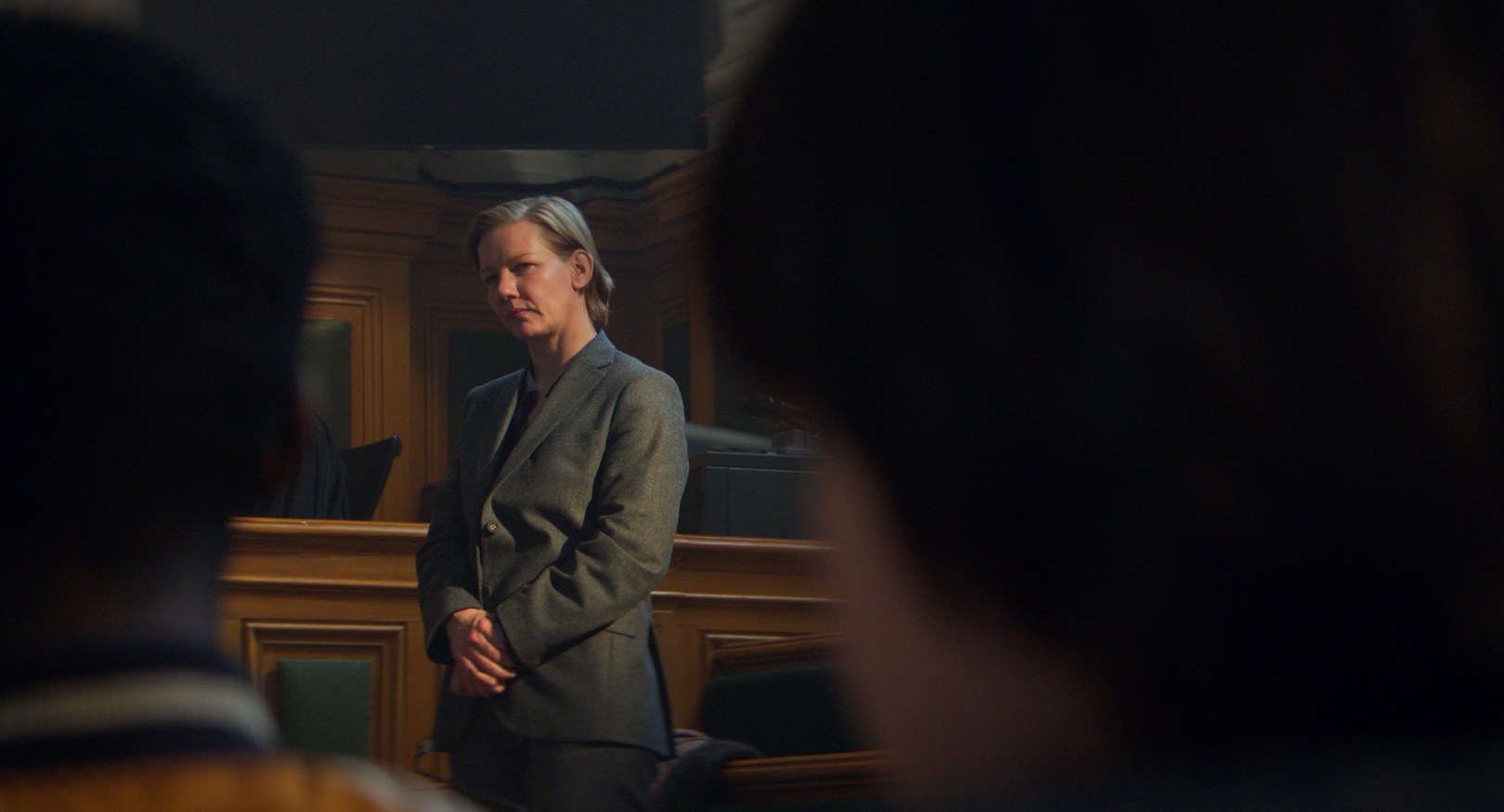
With forensics and splatter experts unable to reach a verdict on how the fall happened, Sandra is indicted and put on trial with the only witness being her son Daniel, who was blinded in a childhood accident. “When we can’t figure out ‘how’ something happened, we can only look further into ‘why’ it happened.” With no eye witnesses and no alibi, the film morphs into a cerebral courtroom drama where a seemingly peaceful marriage is unsparingly dissected under intense cross examination. Violent conflicts, unresolved grudges, buried memories, and unforgiven pasts rise to the surface as more and more conveniently damning evidence is revealed, twisted, and untwisted by lawyers on both sides. Daniel, exposed to the facts of his parents’ relationship for the first time, finds himself wavering in his own truth. He is forced to choose a version of reality to believe in: was it suicide, murder, or just an accident?
Anatomy of a Fall is a critical examination of the more profound layers of marriage and family in the guise of a murder trial. Where much of married life is led with ambiguity and sometimes chaos in the domestic setting, in the courtroom every past utterance becomes evidence to be meticulously taken apart and used against one party or the other. The language barrier that Sandra experiences in a French court of law shadows the more profound barriers that lie between an international couple, both of whom are writers that mold reality with words. Much like the fine line between fact and fiction, there is a fine line between emotion and rationality. The full truth cannot be constructed purely from words and facts presented in a courtroom because there exists no full truth in the complexity of real life, and yet that is what the courtroom seeks to do. Everyone chooses their own version of reality, but a decision has to be made about who was truly at fault for the tragic ending of this marriage.
Sandra is at the center of this exposé, and the profoundness of this character is excellently portrayed by Sandra Hüller, who also starred in The Zone of Interest, winner of the Grand Prix at Cannes this year. On the stand Sandra is stern and collected, but she sobs uncontrollably when sitting alone in a cab. Hüller’s interpretation of her character’s enigmatic strength and vulnerability adds enormously to the depth and mystery of the film. The cinematography has a constant air of distance, but the film is also not without its well-timed comedic moments, the balance between which is a reflection of Justine Triet’s confidence as a director. Thanks to the thought-provoking story and masterful script, I couldn’t take my eyes off of the 2.5-hour film and it only left me wanting more. Triet’s excitingly intelligent feature film is undeniably a bright star in this year’s main competition at Cannes and truly deserved the Palme d’Or.
Written by Isabella Pang
 lariot.nl