
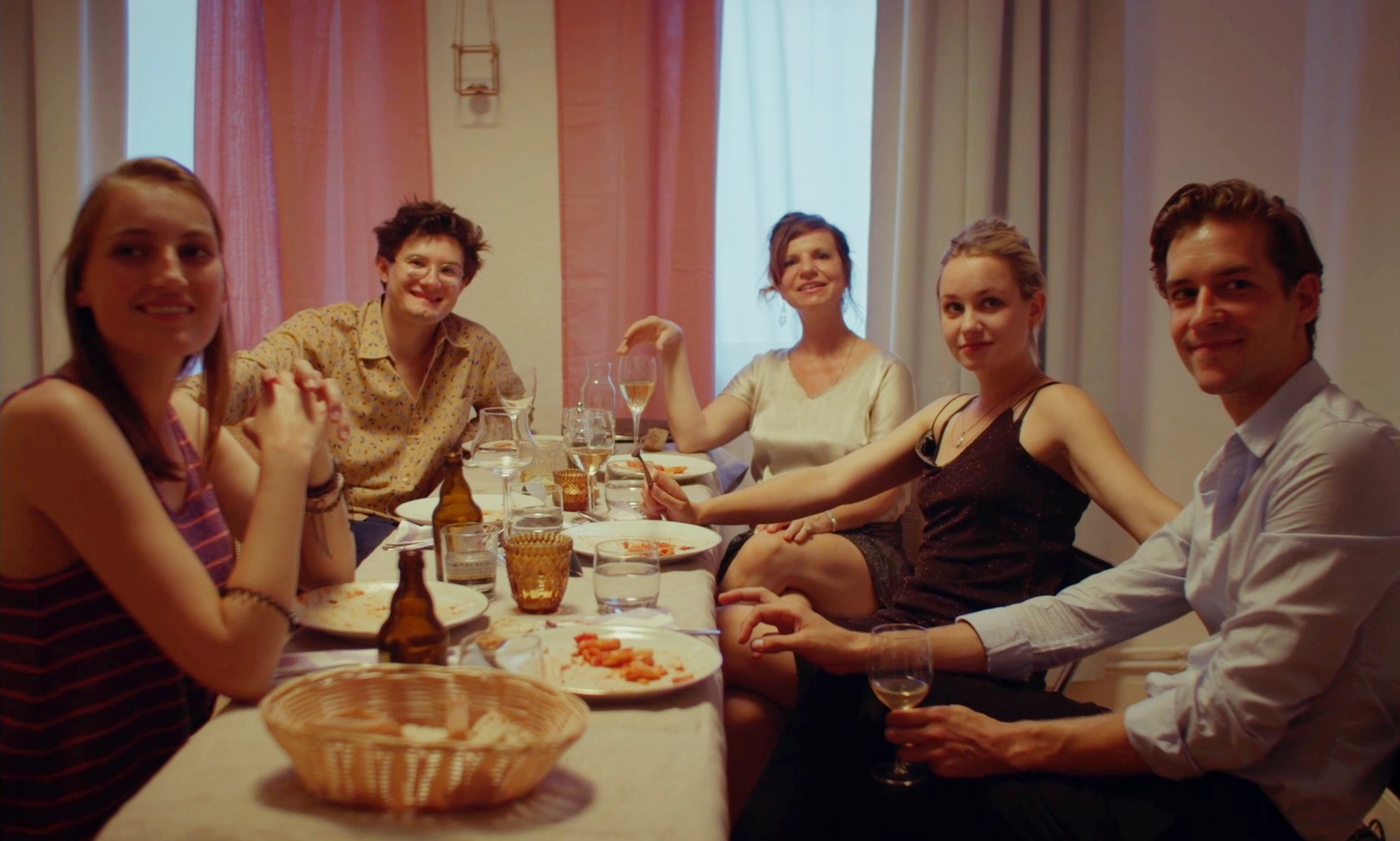
It doesn’t take much for a dinner party to go south, especially if it’s on the eve of a big move from Hanover to Berlin in the midst of a pandemic. Tension runs high and an awkwardly unpredictable guest list consisting of hasty cancellations and uninvited guests pushes the night towards inevitable chaos and breakdown. The bathroom seems to be simultaneously the only blissful escape and the only place where people show their true feelings.
Lukas Nathram’s debut film Letzter Abend (One Last Evening), premiering in the Netherlands at the IFFR 2023 earlier this year, offers a piercing observation of the modern human condition, all within the confines of one small, cardboard box-filled apartment. The film opens at the preparation phase of the dinner party, where Clemens (Sebastian Doppelbauer), recently recovered from his depressive episodes, is writing a song to surprise his girlfriend Lisa (Pauline Werner). Lisa is running around the apartment trying to make lasagna. His best friend cancels, their neighbor invites herself, the lasagna is burnt, and the delivery man for their backup dinner option wants to use their bathroom.
Every little thing that takes place in the film seems to be a minor inconvenience, but when stacked on top of each other becomes a little too real. A power game between Lisa and Clemens slowly escalates as guests start arriving, most of whom seem to only be Lisa’s friends. Clemens fights back in a somewhat weak attempt by inviting the backpacker who was stuck downstairs with a dead phone.
Playful discussions morph into disguised insults as alcohol slowly relieves everyone of their polite social masks and music is proposed to reduce the tension. Clemens barely starts singing before the attention is coincidentally but brutally diverted from him, twice. One of the guests proposes techno, but in the drunken shower of flashing lights, emotions only run higher before the night dissolves into a mellow ending.
Letzter Abend was shot within a week with an intimate and talented team who all contributed to the writing, which shows. It teeters on being a dark comedy piece but is realistic enough for viewers, especially Gen Z, to relate on a personal level. The handheld format and almost improvisational dialogues that ricochet off of each other fittingly render the film incredibly lifelike, but it also feels somewhat theatrical in its caricaturistic choice of characters. The focus isn’t placed on sadness and provokes laughter in the audience rather than tears, but upon reflection we sense the underlying melancholy that is pertinent to the pandemic and its aftermath.
I found the film to be an incredibly pleasant surprise when I attended the IFFR this year, and have been returning constantly to some of the conversations and themes in the film – we keep pretending everything’s fine, but everyone carries emotional baggage that only the owners of which experience, most of the time only in solitary confinement. This generation is largely unsure of the present and doubtful of the future, and it is accurately, albeit a bit dramatically displayed in this film. As a “tragicomedy”, the film is both a light and a thought-provoking watch.
Written by Isabella Pang
 lariot.nl