
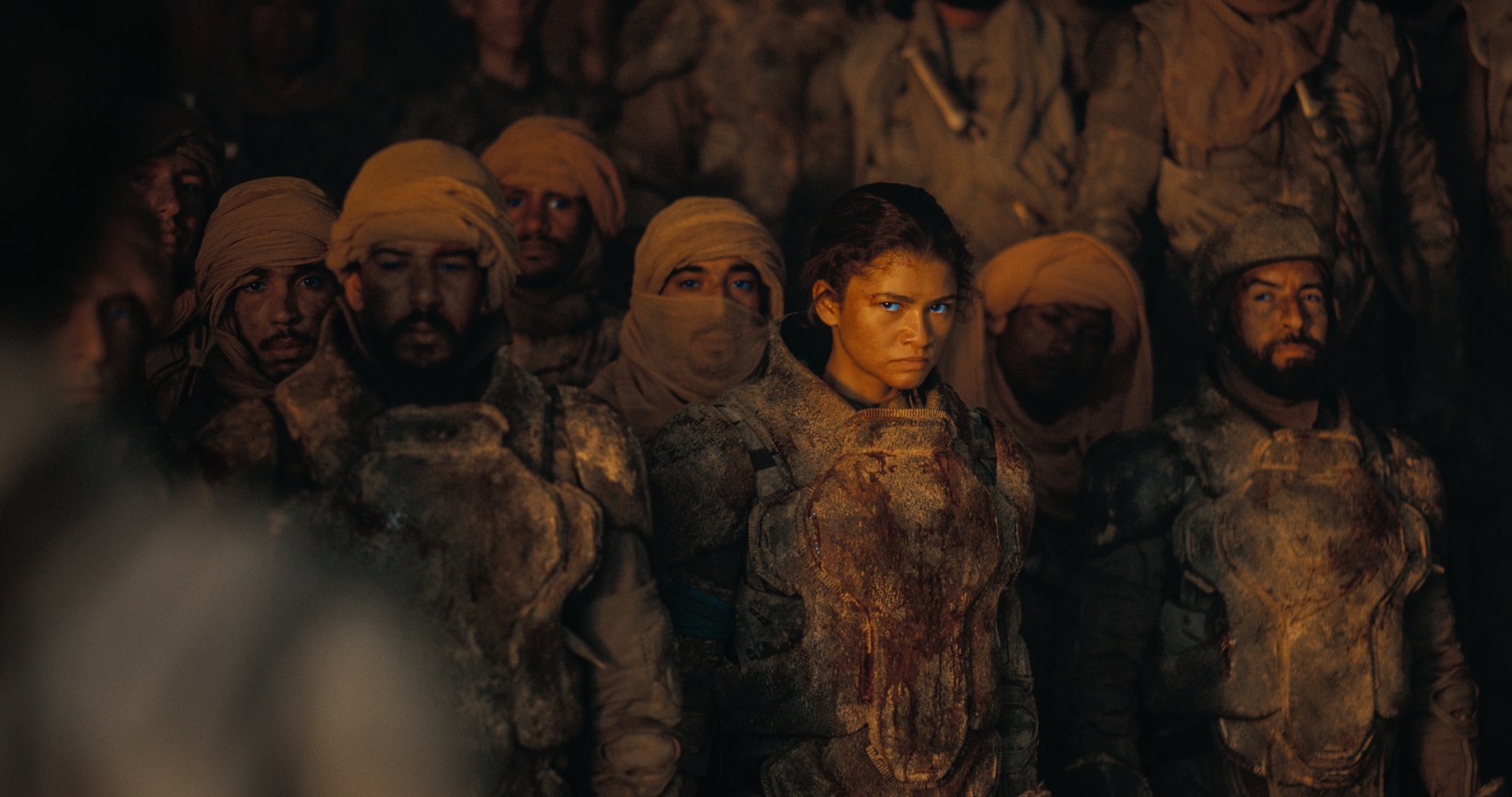
Picture by Warner Bros Entertainment Inc
Dune: Part Two immerses us in the vast, sandy expanse of Arrakis—a world that pushes all forms of life to their limits with its arid climate, where the battle for supreme power persists. Director Denis Villeneuve builds upon the foundation established in the first installment, which introduced us to the intricate politics, myths, and clashing interests within the universe of planet Arrakis.
First of all, I want to talk about the cinematography: The film is beautiful. But like really extraordinary. I always find it difficult to predict the Oscars, but the award for best cinematography is as good as won by this film if you ask me. Every scene looks like a painting, and this is mainly due to the attention given to the environment, for Arrakis this includes the desert in Jordan, which is enchanting together with the music of Hans Zimmer and reminiscent of an Aladin fairy tale.
Greig Fraser: the man responsible for the cameras, designers, and VFX artists have created a world so convincing it lingers in your mind long after the credits roll. The film also dares to innovate. With the use of an infrared camera, rarely used in the film world. The result is the planet of the Harkonnens, that stands out: Giedi Prime. A world without colour. A world so empty, you can only explain it by the word cold, very cold. The planet reflects the brutal and ruthless nature of the Harkonnen rule.
But Dune: Part Two is more than just a visual spectacle. The film fulfils a promise. Or should I say multiple promises. From restoring your family name to liberating the oppressed. Paul Atreides (Timothée Chalamet), is central to this story. And although Chalamet may seem a bit insecure in the first part, he is now driven by ambition and revenge. Even though, according to his own visions, revenge will end in apocalyptic catastrophes.
The strangest thing is that the story is crazy relevant, without you even realizing it. Although the original book was written in 1965 and the story takes place in 10.19. The Fremen, the inhabitants of Arrakis. A population that is the great victim of a resource (spice) that all powerful parties want without paying a fair price. And thus try to cheat everything with politics and military power without any morale. That is very frightening when you think of the American invasion of Iraq, and the abuses of (blood) colbat in Congo, so that we can work towards a green future. While the victims are being left behind in sometimes apocalyptic circumstances. And then the story isn’t as fictional as you thought.
Dune: Part Two is not without its flaws. Because while I do my best to look at my watch in the dark , I do a quick calculation. And I come to the conclusion that a lot of cramming is required in the last 30 minutes. And unfortunately I was right. The film builds to a climax that is good. But it doesn’t do justice to the rest of the film. Because there’s nothing worse than introducing characters who don’t get the chance to prove themselves and challenge the protaganists. And I’m not referring to Feyd Rautha (Austin Butler), but to the army of the Emperor (Christopher Walken), the Saurdakar. The most impressive team of soldiers I have ever seen on the big screen, or at least that was the impression I got in Dune: Part One. The silent soldiers who invade Arrakis in part one and leave nothing behind.
Christopher Walken’s portrayal of the Emperor, while delivered by an A-list actor, unfortunately, comes across as almost senile, a stark contrast to the character’s established image. However, this gives Florence Pugh, playing Princess Irulan, a chance to shine as she navigates the political intricacies with finesse. The casting is exceptional overall, with Stellan Skarsgård’s portrayal of Baron Harkonnen standing out as a masterclass in embodying greed, cruelty, and manipulation, his presence casting a long shadow over it’s opponents.
Experiencing this movie on the big screen was extraordinary, showing what a blockbuster should be—from its visuals to its compelling storytelling. It captures the imagination from the first scene, drawing viewers into its fictional world. Many people and media are saying: “it evokes the same feeling of watching Star Wars, Lord of the Rings, and Harry Potter in theaters” I agree —this film is a defining cinematic event of our generation.
 lariot.nl
