Do not expect too much from the end of the world: but from what world? This is the first question posed by Radu Jude’s latest film, a (very) full-length feature combining modern black & white with the almost nostalgic color of a bygone East-Communist era.
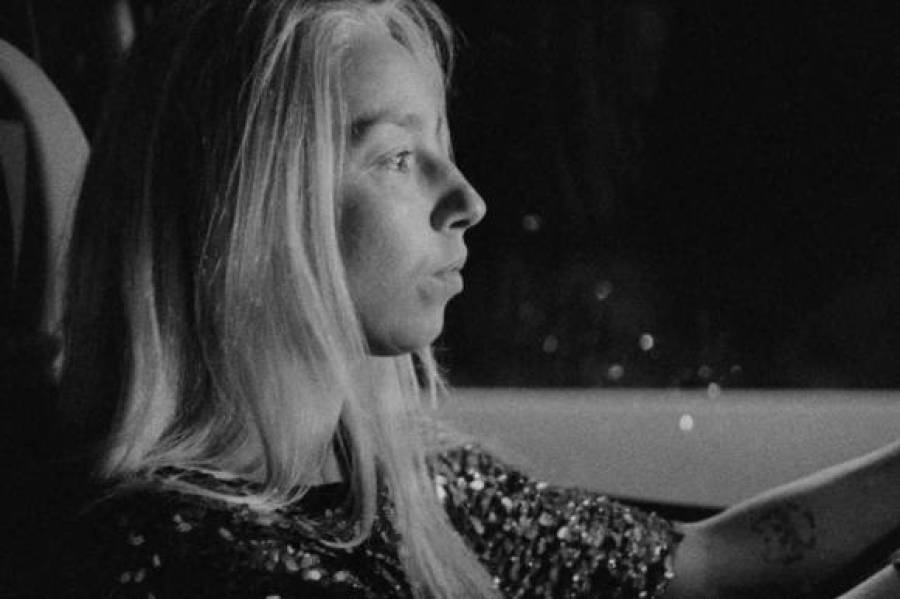
The perfectly absurd film begins with poor Angela, a young female production assistant in a company commissioned by an Austrian multinational to produce a sequence to promote the safety instructions that the company’s Romanian employees must know; Angela, exhausted, wanders through contemporary Bucharest, auditioning casting candidates – all crippled after suffering work-related accidents… who will win the award for the most moving performance to convince those from their previous working-class conditions to wear their helmets in the factory?
Angela is exploited, sleeping poorly, chained to her cell phone which she regularly uses to digitally disguise herself as a man (with the help of those marvelous immediate transformations offered by technology), using the most vulgar language imaginable to amuse her TikTok court with disgustingly gravelly jokes.
In fact, the black and white that encircles the contemporary part of the film could be understood as reflecting the absence of nuance characteristic of a certain era and environment that is too superficial and mediocre because it is empty, where black and white no longer mingle, and are definitively mutually exclusive. Between these two colors, the gray of reflection is no more than an inadequate defense that the allure of indignation and outrageous amusement sweeps away when it passes over the news feeds of any social media reproducing the daily illusions of many of us.
In the manner of an endless and comfortable Manichaeism, we must be black or white. Nuance no longer appears, it’s vilified, it’s not understood.
On the other hand, color reappears sporadically, in a Romania that is still Soviet – through the intermediary of another Angela from times gone by (excerpts from the film “Angela merge mai departe“, 1981, directed by Lucian Bratu), a resourceful young mother driving her cab in a Bucharest that has disappeared. The 1980s, then, the end of the socialist era, the penetration of the market, the emergence of capitalism: the end of a world, as it were, and the rebirth of a new one? Should we have expected anything?
Precisely! Like a hyphen between two eras, we find the Angela of Communist times in color in the liberal black-and-white present, in the suburbs of Bucharest, with her family and adult son, Ovidiu – a former employee of the Austrian firm, confined to a wheelchair for the rest of his life, a crippled condition he’ll try to make the most of by taking part to the casting of that young production assistant with the same first name as his mother (the chosen candidate is promised a nest egg of several hundred euros!).
The absurdity of the film finds its full expression in the denunciation of the most current distractions available (all the technical possibilities, social networks and the stupid, vulgar videos that swarm on them – gags etc.), distractions therefore to the detriment of an almost naive human sincerity of which poor Ovidiu is one of the only heralds throughout the film, along with his mother, Angela, young and then aged.
As he prepares to speak his accidental truth on camera, the event that destroyed his world, he is asked to rephrase his words in marketable, ready-to-use terms, without being too critical of his former employer. Saying nothing about his working conditions, only mentioning the compulsory wearing of helmets, reluctantly declaring himself the product of too much casualness, solely responsible for his misfortune (wear your helmet!)…
Ultimately, this film is an uncompromising look at modern Romania, an Eastern land caught between the bygone days of apparatchik communism and the contemporary liberal era of the European Union. The film’s black-and-white present sees the country fall prey to Western European firms, which relocate there at low cost to formerly socialist buildings on the outskirts of Bucharest.
So, do not expect too much from the end of the world – alienation by any regime is only acceptable if you manage to laugh at it for a fleeting moment, to look it in the face and insolently.
Do not expect too much from the end of the world, 163 minutes, directed by Radu Jude (Romania), available on Mubi
 lariot.nl