The Settlers (Los colonos) by Felipe Galvez Haberle – in which some of the racist and national violence of a fledgling state – Chile – is brought to light: the twentieth century has just dawned, and in South America topographical measures are being taken to map out a territory according to the directives of the most European law and its best ally: property.
José Ménendez (1846-1918),[1] a large landowner in Tierra del Fuego (a territory at the very end of the world, at the southern tip of Chile) commissioned three men to go and survey his lands, which were so vast that they could not really be surveyed at all (it took days on horseback to cover his land). This is because the gigantic estate that the fledgling Chilean administration has given him is being visited by its former inhabitants, the Selk’nam Indians, who are scouring a countryside whose violence they know nothing about once it falls under the sway of a property right that is contrary to all justice.
In the service of this right that Mr Ménendez wishes to uphold at all costs, three men set off on a mission to ‘clean up’ the valleys of the said ‘offenders’: the lawlessness is on the march…
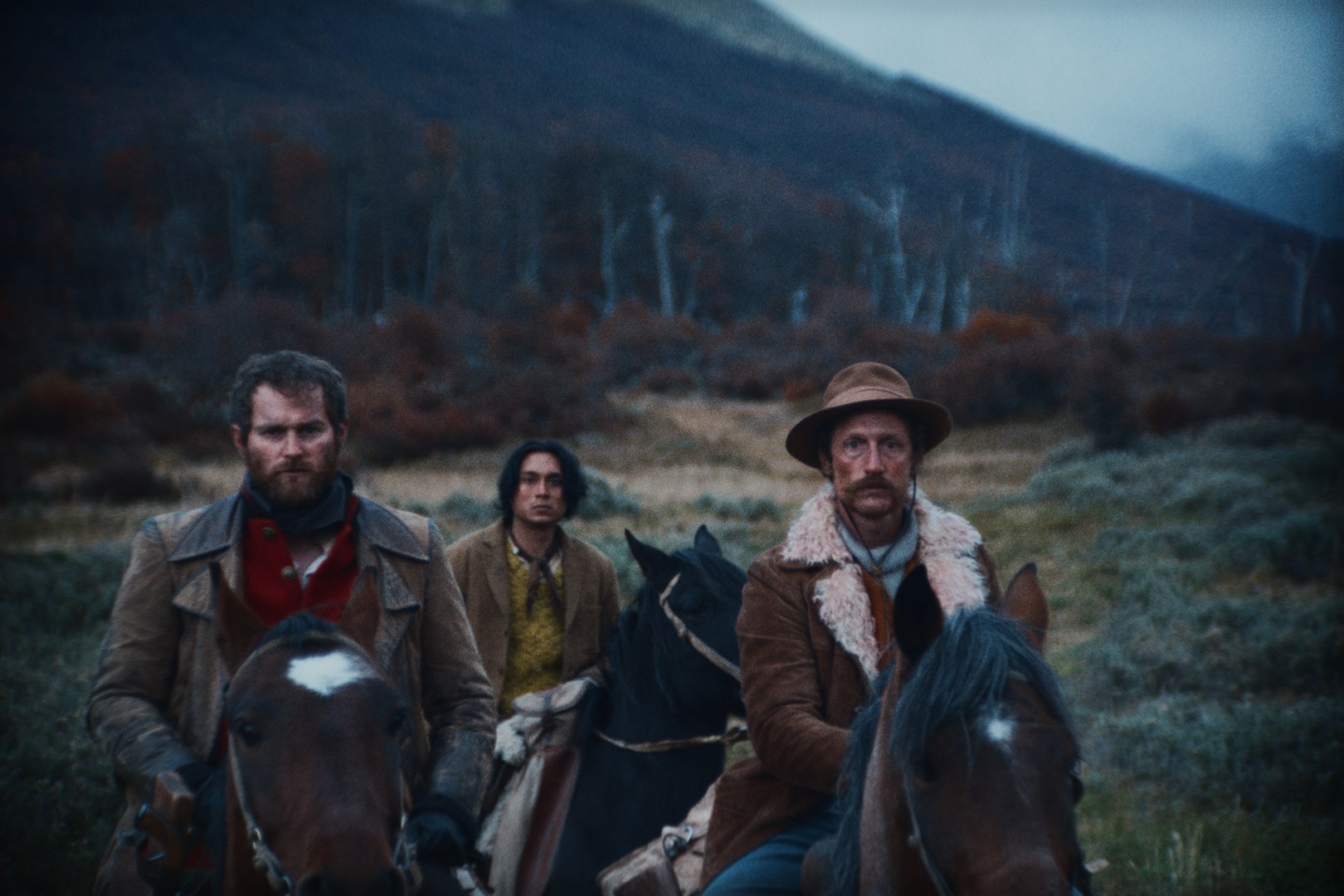
Mac Lennan – a former Scottish soldier, Bill – a mercenary of fortune from the Texan Americas, and Segundo, a young Chilean Mestizo (the name given to people born of a mixed couple, native Indian – European settler) together form the sad team under the tycoon’s orders.
This feature-length film is probably about violence that is both shown and suggested, about a desire to show the transformation of a territory and the subsequent use made of it almost a century ago to fulfill the ambitions of a national state – the nation, this idea of the 19th century that was first European and was then perpetuated elsewhere, for example in those South American countries that have just been constituted or drawn up, that have emerged from the ruts of colonialism but still prey to its demons.
The massacres of Selk’nam Indians, the rapes of Selk’nam Indians, the humiliation – that symbolic violence which is sometimes imperceptible at first – inflicted on men by others on the pretext that they are not like them; the systematic racist violence aimed at denying a previous state of existence, making those who are not recognised forget through blood, even to the point of exterminating them.[2]
All this brutality that sullies a South American flora and fauna that is so majestic and grandiose: in the end, perhaps this is the only view that briefly consoles us – this variety of natural settings that, taken in their entirety, soften in a fleeting way an otherwise definitively somber picture.
So what can we learn from this journey through time and geography? That violence, when it is established in the most mechanical way, is clearly supported by the law and by the first of these, property; that the use made of it, once misused, serves the interests of those to whom nothing can be refused because they own everything. Such was the exact situation of Mr Ménendez, a large landowner, who managed the administration of the Tierra del Fuego under state authority even when the abuses committed by his three henchmen against the Selk’nam Indians came to light.
Another of the movie’s strengths is that it illustrates the transition from a state close to the “Wild West” where the most savage form of property reigned (around 1900) to another, slightly later (around 1910), which saw the advent of the Chilean state, created by the former settlers. This political creation was accompanied by an essential desire to create a national identity for everyone – in particular for the Selk’nam Indians, who had become Chileans and had previously been hated and/or murdered.
All the violence that makes a nation! Yes, the artifice of the historical narrative does not stand up well to the extraction of a little of the red blood that lies in its most unspoken depths. And it’s certainly worth taking the courageous step of suggesting a more critical perspective on the construction of the national idea, which is founded first and foremost on oblivion.
The Settlers, directed by Felipe Galvez Haberle (2023, Chile), 97 minutes, available on Mubi
[1] See: https://en.wikipedia.org/wiki/Jos%C3%A9_Men%C3%A9ndez
 lariot.nl