
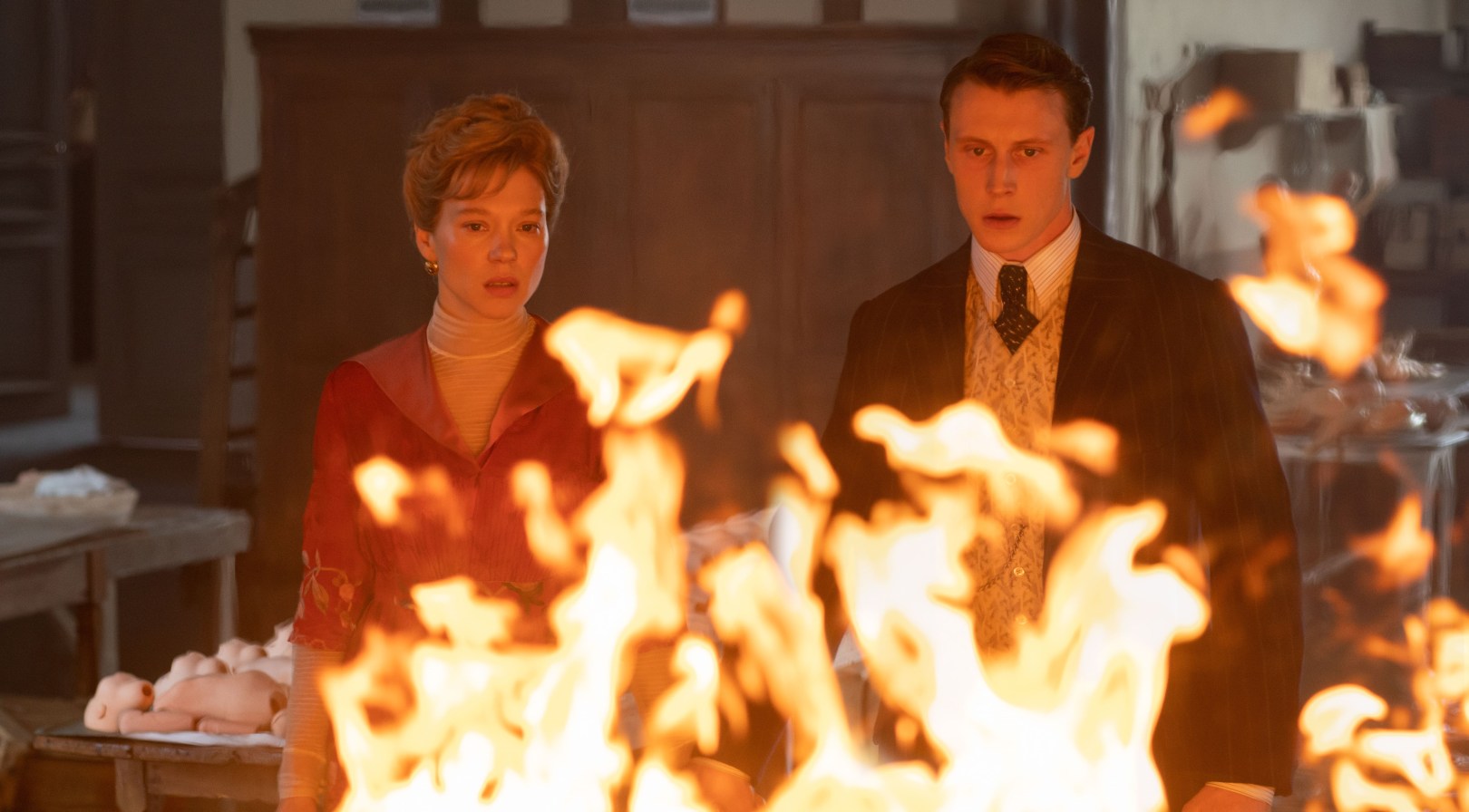
Photo: Carole Bethuel
In “The Beast,” directed by Bertrand Bonello, we are immediately thrust into a surreal world. An actress, portrayed by Léa Seydoux, stands in a green screen setting, receiving instructions from a director. This opens what seems to be a fantastical film, but this horizon proves deceptive. “The Beast” is a melancholic and technophobic film that speculates on a future (2044) dominated by AI, where emotions are lost and a love story from the 1910s is tragically repeated.
The film shows how the love of the actress, Gabrielle Monnier, played by Seydoux, continually blossoms and fails across different eras. Gabrielle, portrayed in various incarnations as an artist or model, repeatedly falls in love with a man, played by George McKay, reliving the same tragic failure each time. The film’s most memorable moments are linked to music, such as “Fade to Grey” by Visage and “Evergreen” by Roy Orbison, which are used anachronistically throughout the film.
Bonello suggests that the future is already written in the past. The film’s quest for love contrasts a lyrical and tragic past with an empty, emotionless future, where people can erase their emotional memories like wiping a hard drive. The film emphasizes that true love can only survive by preserving the emotional history of humanity, largely represented by the arts. This melancholic memory, in the filmmaker’s view, is preferable to the cold, inorganic world of AI.
A secondary character, a black doll with blue eyes, symbolizes AI’s lack of emotion. She takes Gabrielle to clubs to dance but feels nothing. This character could have provided an interesting counterpoint, but is confined by the nostalgic framework on which the film builds its discourse and style. The year 2044 is depicted as a dystopian world, with deserted, dehumanized streets and constant threats of pandemics.
Traveling through time means starting over. This cycle suggests that sacrificing emotions and the art that feeds on them to AI’s coming dominance is a sanitized nightmare. Gabrielle Monnier’s final scream signals a return to the old order of passion, a new variant of the catastrophe announced in the opening sequence. From Belle Epoque salons to retro-futuristic clubs where she listens to Roy Orbison while crying, nothing ultimately changes. Reliving love to the point of death: this is the tragic program on which “The Beast” falters.
Bonello’s cinema seems an attempt at an impossible junction between his memory overloaded with recollections (more references, music, and melancholy) and the vast green screen that promisingly opened the film but remains ultimately out of reach.
 lariot.nl