
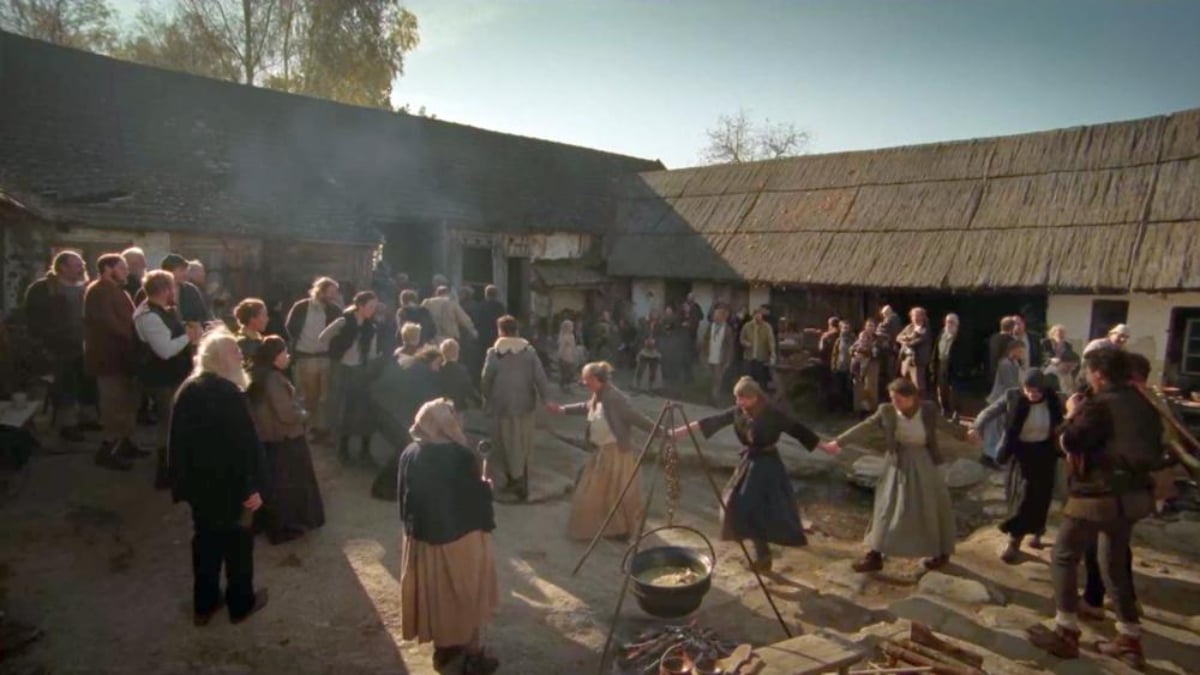
Des Teufel Bad (The Devil’s Bath) by Veronika Franz and Severin Fiala: a small farming community in 18th-century Austria, a suffering young married woman – Agnes – obsessed with the idea of having a child, and Wolf – her husband, flanked by his brittle mother – unable to grasp the malaise eating away at his wife.
These were not times for gentle mental health, at least, the mystico-religious remedy that was imposed on the “possessed” – these failing minds (future mental patients!) – sought first and foremost to strengthen the Church’s hold on the deviant body considered prey to the Devil.
Thus : Agnes, after several delirious episodes, is taken to a sanatorium where a sort of wire is inserted into the back of her neck, a device she must shake in the event of a crisis: confusing physical pain with torment of the soul!
Agnes, the heroine, is in a constant state of decline: it’s a bad end that’s been foretold from the start – as soon as she marries and starts working in the fields, no one can really hope for anything more. We assume that she is spiritually elsewhere, without really knowing where – she seems to be floating.
Imprisoned in otherwise enchanting sylvan valleys, her illness consumes her, and the rural landscapes that ultimately surround her appear only as silent witnesses to her agony.
The film, which is quite long, relies mainly on the superb Austrian rural setting of the 18th century – the forests of green moss covering the rocks and ground – to set the scene for a horror tale in the style of that part of Germanic literature that was to create them a little later, at the beginning of the 19th century.
But this is horror cinema that we’re talking about here! In this sense, the viewer is spared nothing: decapitation and a subsequent shot of the bloody head; suicide and a subsequent shot of the stiff corpse being thrown into a mass grave, and so on.
The subject of the work – inspired by the documented cases of several 18th-century peasant women who “committed suicide by proxy”, first murdering, then denouncing themselves to the authorities and suffering an “official” death that would allow them to avoid eternal damnation – this subject, although correctly exploited according to the canons of ‘horror’ (fear on command, etc.), nevertheless leaves us dubious as to its general treatment, i.e. as to the borrowing of customs from another era for the contemporary screenplay needs of a film team hoping to meet the expectations of an audience eager to experience a few easy sensations on the big screen!
The 18th century is not to be trifled with. That the society, morals, and social environment of the time are largely incomprehensible to us unless we undertake a study that is difficult to translate into film: perhaps!
That these elements should be used to construct scenarios depicting a similar distant history through the modern pornography of death that often litters the horror of cinemas is, in my opinion, something to be contested! Indeed, I think it is not a good idea to caricature the lives of those who came before us using codes and secret desires that only we, moderns, understand.
And while the film’s entire scope cannot be reduced in this sense, watching it nonetheless produces a mixed feeling of incompleteness and ease, tinged with skepticism.
“But cinema is essentially modern, you may say, and it is the contemporary spectator who must first be able to understand it!”- Certainly, but any understanding implies an effort, and I can’t help believing that we need to compromise between the subject and the way it is dealt with, to preserve both as best we can!
Failing that – in the case of a movie that is too accentuated in one sense – the risk would be to counterfeit a picture that surely deserved to be more nuanced.
The Devil’s Bath, directed by Veronika Franz and Severin Fiala (2024, Austria), 121 minutes
 lariot.nl