Religion is a sovereign, ruling state entity in parallel to national political systems. The institutional apparatus of Catholicism, formed over the centuries, remains the most powerful of such formations, due to the global position of the absolute monarch of the Vatican – the Pope.
In the country I come from, the word “pope” does not describe the general role of the head of the Catholic Church, but rather evokes a very specific figure of Karol Wojtyła, known primarily to the world outside of the Polish borders as John Paul II. To contextualize the meaning of one’s statement, which aims to refer to the current Pope, it would be preferable to invoke the specific pontifical name, such as “Francis”, “Benedict”, “Pius” or “Peter”, to avoid unnecessary misunderstanding.
The person of John Paul II leads the convoy of contemporary Polish heroes, right next to personalities such as Lech Wałęsa. In turn, the legacy that the Pope left behind is constantly shaping social discourse, and quite often serves as the cause of disputes between opposing political camps.
“Pope” is therefore a word that provides refuge for many institutions, ideas, beliefs or concepts that construct human systems and traditions. The head of the Catholic Church, the absolute monarch of the political state, a Polish national hero, a religious symbol, a potential future saint. The Pope is an honorary and responsible role. Therefore, it is no wonder that every organized Conclave, with its dose of mystery and tension-building ritual, is always such a huge event on a global scale…
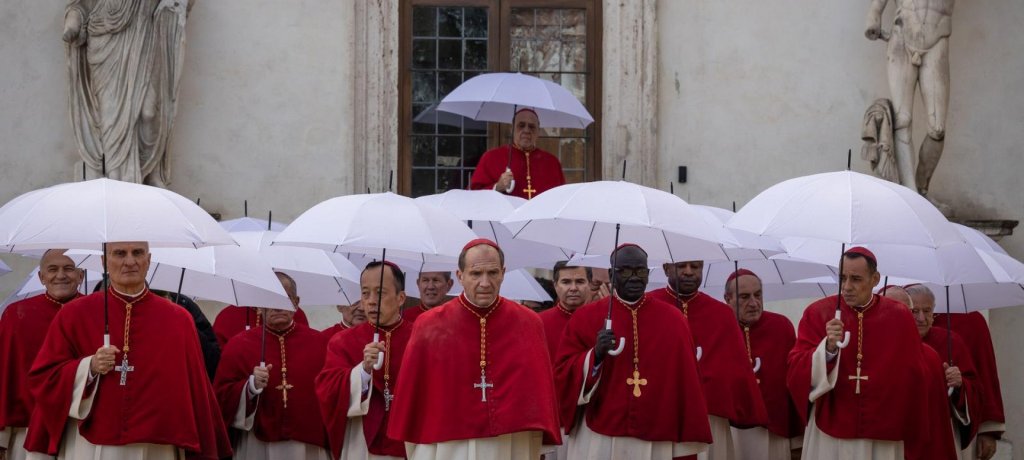
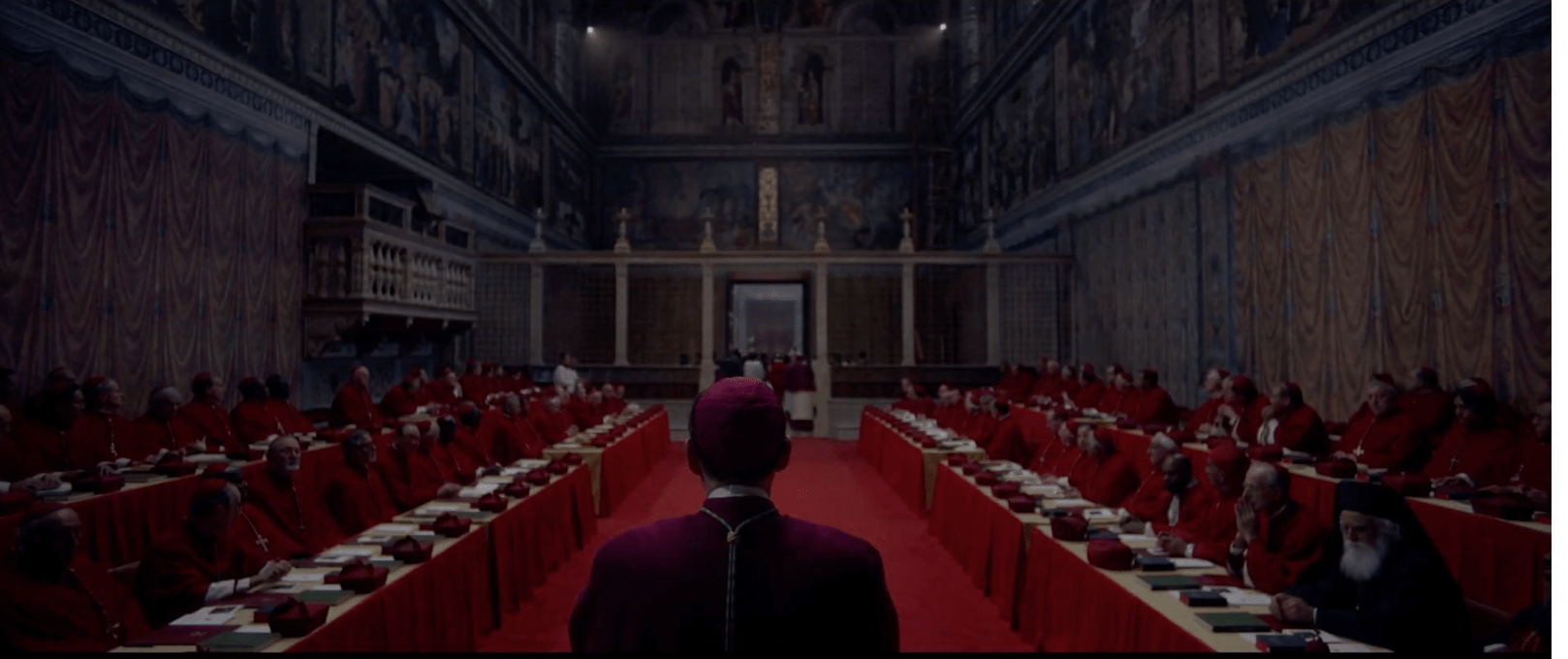
A film with a very telling title, “Concalve” (2024), directed by Edward Berger, is a thriller reporting on events surrounding the death of the old pope and then the election of a new one. The entire movie takes place in one of the historic Vatican buildings. The viewer can admire the beauty of Italian architecture in truly Renaissance frames – that is, by maintaining an almost sophisticated perspective. Truly fascinating about this production is that the motifs from the previous centuries did not constitute the full picture of the representatives of the modern Church. Alongside marble sculptures or richly decorated frescoes, the elements decorating the scenery were smartphones, coffee machines, and even electronic cigarettes – all as part of the daily routine of the archbishops gathered in the Vatican.
“Conclave,” as a picture of one of the most ceremonial undertakings on this globe, presents its participants as people no different from any of us – regardless of whether we adore the Pope as the real head of the Church or merely as a character in a Hollywood feature film. Berger does not judge, does not condemn, does not wash away the Church’s sins either. He points out that the clergy are simply people whose frequent wrongs result from mistakes, not from a corrupt heart (excluding, of course, extreme cases such as pedophilia or other forms of sexual violence). What often constitutes a real evaluation of the moral attitudes of priests, who supposedly should function as a socio-cultural morality model, is the scale of their remorse (or arrogance) towards that personal misdeed. “Conclave” plays with those two stances, present in the modern world, that regard one’s position towards faith and its institutions, in an absolutely fantastic and unconventional way, drawing on the arguments of each side. The world is not dualistically divided, and even in black and white schemes, we will always find at least one additional color, standing out above the rigidly established framework.
I expected from “Conclave” a sharp criticism of the current condition of the Church in the global political arrangement. Instead, I got a detailed analysis of human nature in the face of metaphysical concepts, but also those essentially terrestrial – such as power, money or war. And I cannot say that I was disappointed. We will not eliminate the Church or the papal tradition, which has survived so many centuries and is still present in the creation of modern societies. In return, we should think about how to improve the institutions of faith so that they harmonize with the current world and its issues. “Conclave” is not a film revealing the dark secrets of the Church, but rather – profound problems of human nature, which concern each of us, secular and clergy. And to change the Vatican’s policy, we should first get to know the scheme of our own actions. For example, by familiarizing ourselves with Berger’s “Conclave”…
Written by Agata Zagozdzon
 lariot.nl