
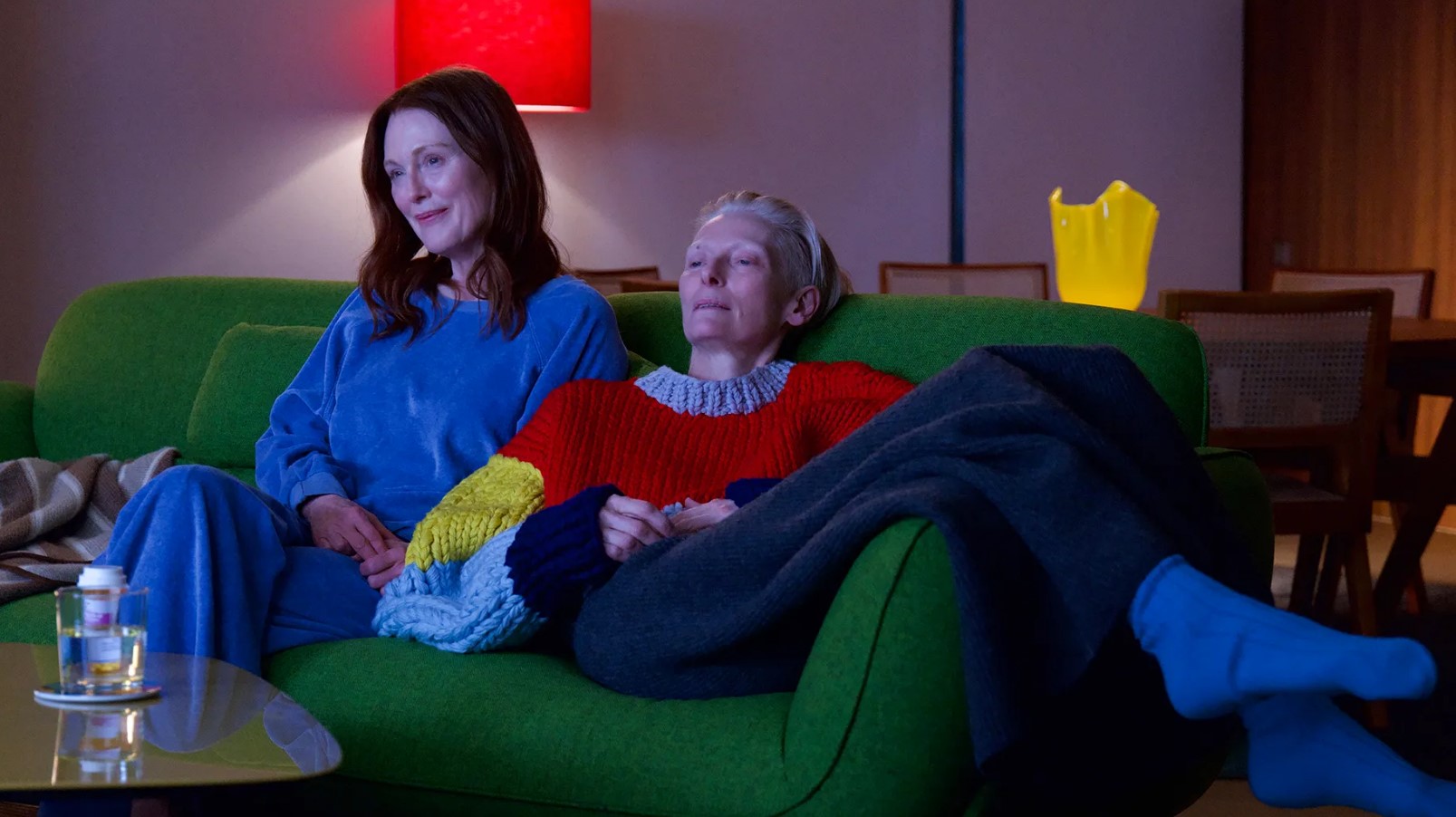
Pedro Almodóvar’s first full-length English-language film, The Room Next Door, is a poignant meditation on mortality, friendship, and the ways in which we confront life’s inevitable tragedies. Anchored by stunning performances from Julianne Moore and Tilda Swinton, the film gracefully examines the complexities of human relationships against the backdrop of death.
The story revolves around Ingrid (Moore), a successful author promoting her latest book, On Sudden Deaths, in New York. Her life takes an unexpected turn when she learns that Martha (Swinton), a former war correspondent and an old friend, is in the hospital battling terminal cancer. Determined to maintain control over her fate, Martha reveals her plan for a dignified end through assisted suicide, and she persuades the reluctant Ingrid to accompany her on this final journey. The two women retreat to a secluded countryside villa, where they confront their pasts, explore their diverging perspectives on death, and craft a plan to ensure Martha’s passing avoids legal complications.
Almodóvar masterfully brings his characteristic cinematic vitality to this heavy subject, balancing his vibrant visual style with restrained, introspective storytelling. The static, measured close-ups invite viewers into deeply personal moments as Ingrid and Martha exchange heartfelt dialogues, often revealing literary and philosophical undertones. These moments are a testament to Almodóvar’s evolution as a filmmaker, shifting from fiery passion to a quieter exploration of the human condition.
Thematically, The Room Next Door delves into the inevitability of death while celebrating the fleeting beauty of life. Martha, who has lived fearlessly on the frontlines of war, confronts death with a calm acceptance, while Ingrid, who has always feared its shadow, finds herself reevaluating her beliefs and values. As the two women navigate this liminal space, they offer reflections on love, grief, and what it means to live authentically—even in the face of tragedy. As Ingrid poignantly states, “There are many ways to live within a tragedy.”
Visually, Almodóvar’s signature style is evident in the film’s meticulous composition and lush color palette, though it is tempered by a more somber tone. The countryside villa becomes a character in itself, its quietude mirroring the stillness of impending loss. Yet, even amidst this stillness, Almodóvar finds moments of beauty, underscoring his belief in the significance of how we choose to live each moment, no matter how fleeting.
Moore and Swinton are magnetic, embodying their characters with a depth and nuance that make their journey achingly real. Moore’s portrayal of Ingrid’s initial hesitance and eventual transformation is both subtle and profound, while Swinton’s Martha exudes strength and vulnerability in equal measure. Together, they create a dynamic that is as compelling as it is heart-wrenching.
The Room Next Door is a contemplative work that invites viewers to open the metaphorical door to their own reflections on life and death. It is a film that asks difficult questions and refuses easy answers, ultimately celebrating the enduring power of connection and the quiet strength of love. Almodóvar’s English-language debut is a triumph, marking a new chapter in his illustrious career while retaining the essence of what makes his storytelling so uniquely powerful.
By Antonis Lappas.
 lariot.nl