
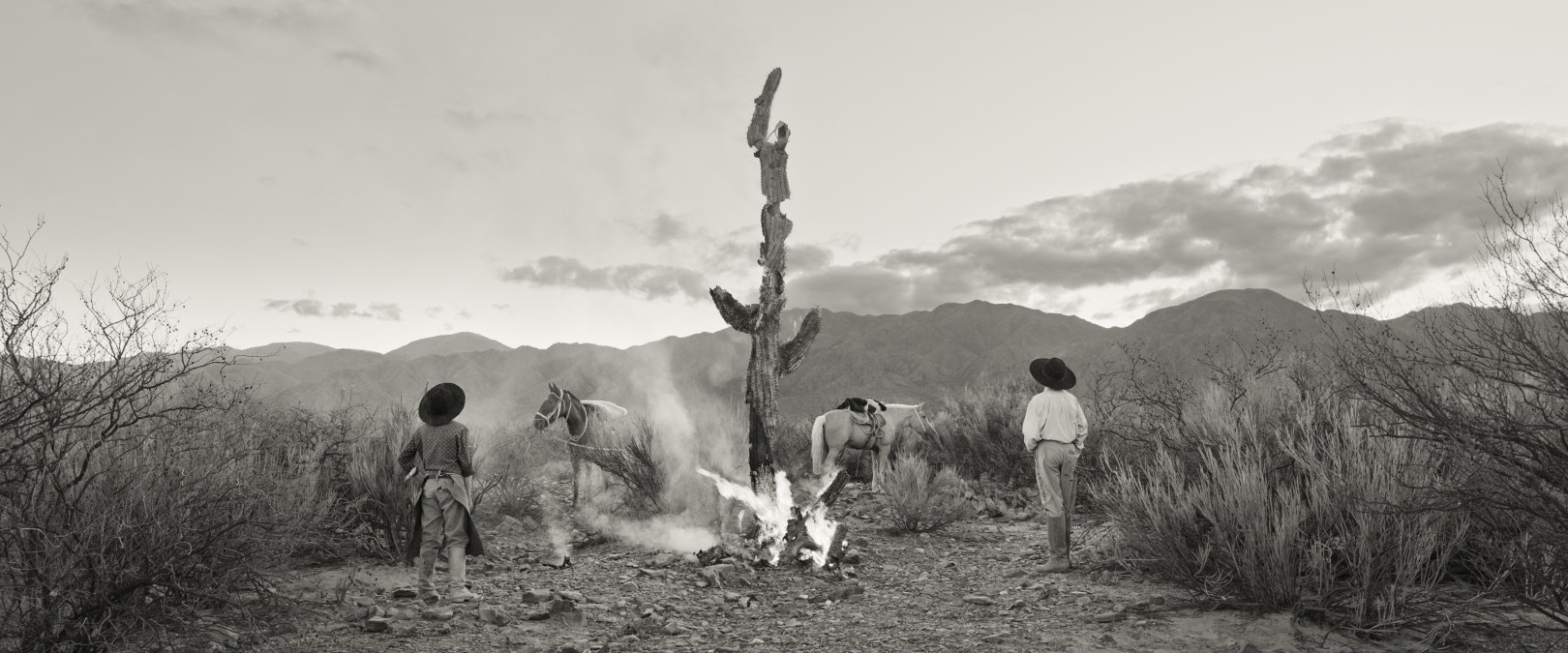
From the opening shot, I knew I would love this documentary. We see a gaucho (cowboy) lying on top of his horse in the early morning hours, slowly waking up in an Argentine valley. This shot immediately sets the tone for what’s to come: a peek into the lives of cowboys and cowgirls in the twenty-first century. We follow different people — two young aspiring cowboys, a father teaching his son the ins and outs of his trade, an elderly man reflecting back on his life, and a teenage girl who wants to become a successful rodeo rider.
This film is a true feast for the eyes, each shot is set up in a way that we can’t look away, crafted by cinematographers and directors Gregory Kershaw and Michael Dweck. The alteration in shot composition makes it very interesting to watch. The film is shot in black-and-white, which I interpreted as showing the unison of this community, though I do wonder what colors lie behind it.
One of the themes in this film is the cycle of life and passing the gaucho trait on to the next generation, which allows the viewer to learn together with the young gauchos, making it fun to go along for the ride (both figuratively and literally). We see what problems they face, such as an increasing condor population killing cattle, and what they desire, for example becoming a rodeo star. But at its core, it is a film about keeping traditions and culture alive, and how we want to be remembered. It stands in stark contrast to our Western way of life, where every second counts.
Furthermore, I truly think there is something for everyone in this documentary, thanks to the many perspectives we get. Personally, I resonated most with the teenage girl (Guado Gonza) as she is of similar age to me. She is practicing to become a female rodeo rider, while also attending a school where she does not fit in. We see her fall down quite a few times (as one does in rodeo), but never give up or be scared to try again. Because the viewer gets multiple perspectives, the stories feel authentic and personal, while still remaining respectful. It is not afraid to make the audience laugh, but never in a mocking manner. Too often, documentaries feel exploitative, leaving behind a bad taste. Not this one. It gives a glimpse of the good and the bad of the gaucho gaucho — the real gaucho — life.
Written by Julia Kamphuis
 lariot.nl